AI shopping agents never look at your product. They read it.
Build buyer confidence, fast. For people, and now for agents.
Voxelo is a new content workflow for ecommerce. Capture a 3D twin of the real product from a short video. Create everything the product page needs: photoreal 3D, place-in-space AR, product and lifestyle imagery. Publish rich, agent-ready attributes read from the product itself, not guessed from a title. Most pages give an AI shopping agent a dozen thin attributes. A twin gives it two to three times that.
- 01 Capture a 3D twin
- 02 Create the content
- 03 Publish agent-ready attributes
JSON-LD · Partner API · Webhooks · Free to start
Live 3D twin · Drag to rotate · 35 attributes read from this capture
You can be filtered out
before anyone visits.
Rich, structured product metadata, consistent naming and taxonomy are fast becoming prerequisites for appearing in AI-mediated journeys at all.
McKinsey & Company, March 2026The same research warns that brands whose differentiation an agent cannot parse risk being filtered out upstream, before a shopper ever reaches the product page. BCG puts it more bluntly: an agent can only recommend what it can find.
Build buyer confidence, fast.
That was always the job. What changed is who needs convincing first. One capture now has to satisfy a machine that reads and a person who looks.
A dozen attributes, or a few dozen.
A typical product page carries around twelve attributes, most inherited from a feed or inferred from the title. Voxelo reads the product itself, and scores its confidence in each one.
Attributes, largely from a feed. Colour, size, category, a short description for a human skim-reader. Enough to list the product. Rarely enough to win a comparison.
For many categories, Voxelo averages two to three times the attributes seen on a typical PDP, read from the capture of the real product and published as JSON-LD alongside the 3D twin.
Read from the product,
not guessed from the title.
Whether an attribute holds up depends on where it came from. A model asked to describe a shoe from its name produces something plausible. A capture of the actual shoe produces something true.
- Every attribute traces back to a capture of the real product
- Suede, knitted mesh, stitching, weave and weathered surfaces all survive the capture
- Each one carries a confidence score, and your team can edit or add to them
- Nothing is invented, so nothing to retract when a buyer checks
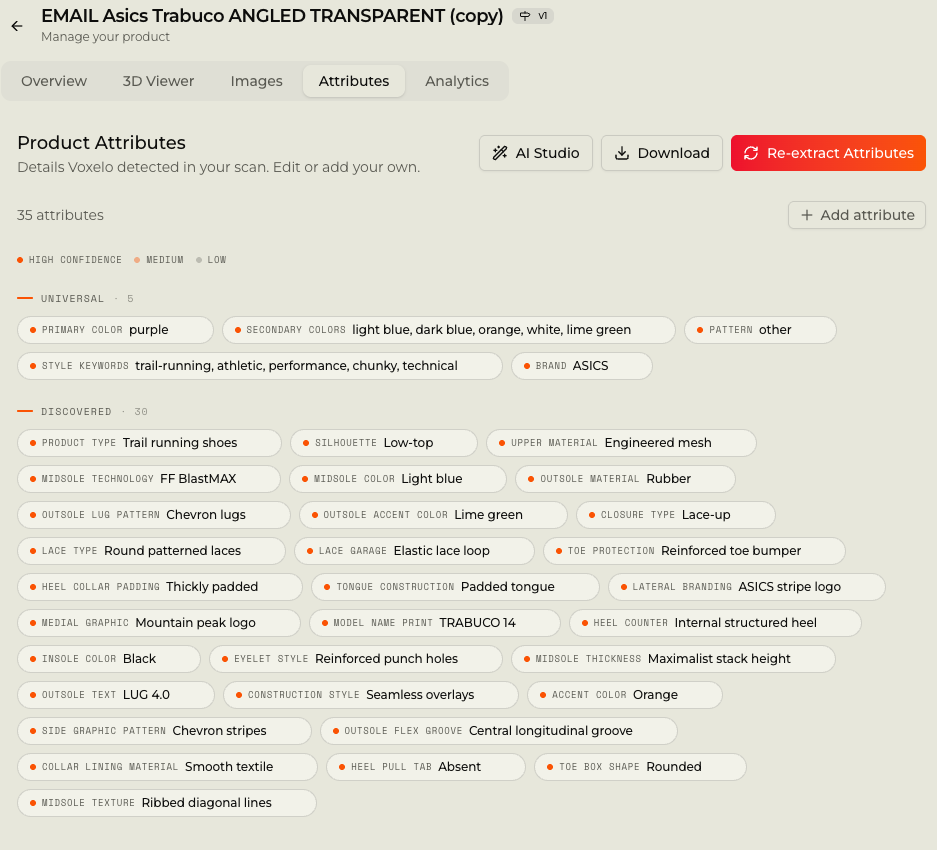
Real output · 35 attributes from one capture · Confidence-scored, editable, exportable
The agent shortlists it.
A person still has to buy it.
Being recommended is the first job. Converting the shopper who arrives on it is the second, and the one your page has always had. The capture that feeds the agent is the same one that builds confidence to buy.
Photoreal 3D
An interactive twin of the real product, not an approximation modelled from reference shots. Drag it, turn it, look underneath.
Live twin, running here
Place-in-space AR
Native to every Voxelo 3D twin at no extra cost. One toggle publishes it. Shoppers install nothing to put the product in their room.
Recorded on an iPhone, true to size · See the AR page →
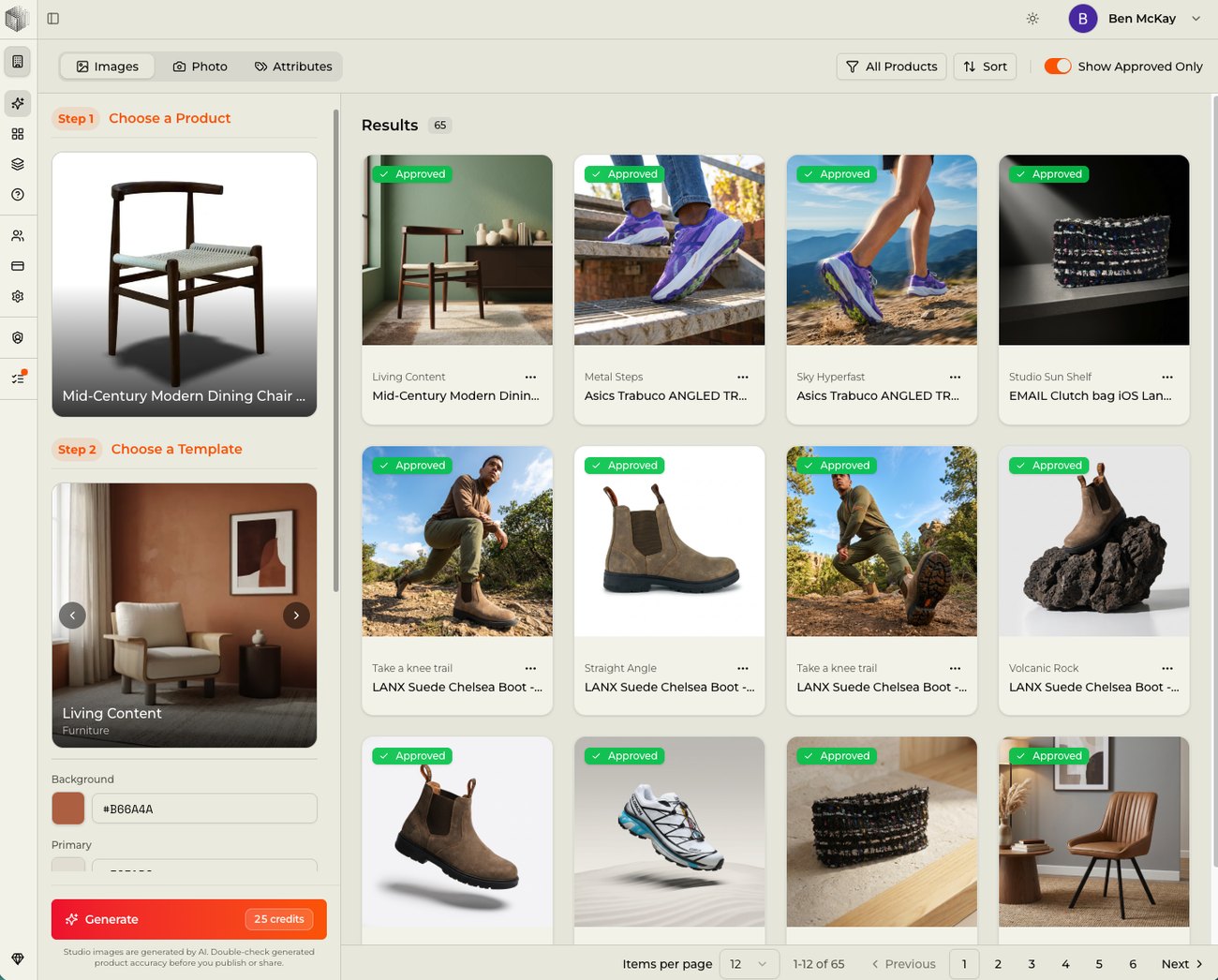
Product and lifestyle imagery
Studio-quality stills and on-brand scenes generated from the same twin, so every asset shows the same product.
Generated in the app from the twin
Categories where detail decides the sale.
Capture rewards products with texture, construction and finish to describe. These are the categories where a thin feed loses the comparison and a captured twin wins it, for agent and shopper alike.
Footwear
Uppers, lug patterns, stitching, collar padding and midsole, read from the shoe itself.
Footwear →Fashion
Weave, drape, trims and finish, where the difference between garments is rarely in the title.
Apparel →Bags
Grain, hardware, linings and panel construction, the details a buyer zooms in on.
See the gallery →Furniture
Joinery, timber, weave and upholstery, plus the AR that answers “will it fit”.
Furniture →It ships as data, not as a deck.
Attributes publish as JSON-LD on the page. Everything else is available programmatically, so it scales to catalogues of thousands, and to content and product archives that need one version of the truth.
JSON-LD on the page
Attributes publish as structured data beside the twin, in the form crawlers and agents already read. No separate feed to maintain.
Partner API
Create a product, upload the capture, start processing and pull outputs over REST: PLY, SOGS and AR, with idempotency keys and cursor paging.
Webhooks
Subscribe to processing.completed and processing.failed, verify the signature, and drive your pipeline without polling.
- Under three minutes to capture, and the twin is on-site in around an hour
- Bring splats made elsewhere, or make them from video in the platform
- Free to start, with hosting and a viewer included, then from £20 a month
Explore the platform.
What shipped in 3.0
Attributes as JSON-LD, 100 splats hosted free, Virtual Studio in beta and the Partner API.
Free 3DGS hosting
Bring splats you made anywhere. Hosting, a viewer worth embedding and AR on every one.
Place-in-space AR
Native to every twin, free, with nothing for your customers to install.
How capture works
What a good capture looks like, and how a short video becomes a twin in around an hour.
Sources · BCG, “How Retailers Can Reinvent the Digital Flywheel for Agentic Commerce”, October 2026, survey of 150 retailers and brands · McKinsey & Company, “Europe’s agentic commerce moment”, March 2026, Consumer AI Discovery Survey, December 2025, 749 respondents across France, Germany and the UK · Attribute counts are Voxelo platform data